How I run my whole life on GTD, with ChatGPT and Claude Code on the board
The maker of GTD Brain on running a company, life admin, travel plans and a move between countries through one Getting Things Done board, with an AI agent clarifying the inbox, ChatGPT as a capture surface, and Claude Code doing some cards start to finish.
Start free for a month →No charge for your first month · Cancel anytime
On this page
I built GTD Brain because I needed it, and I am still its heaviest user. Everything I do runs through one Getting Things Done board: the one-person software company I run, the apps I ship on four platforms, paperwork, travel plans, and the half-formed ideas that show up at 2am. What finally made GTD stick for me, after years of falling off it, is that I stopped doing the tedious parts myself. An AI agent clarifies my inbox into next actions, I talk to the board from ChatGPT when I am away from my desk, and some cards get done by Claude Code without me touching them at all.
This article is the honest version of that setup: what the method does, what the AI does, and what still only works if I show up.
One inbox for the whole mess
I used to keep work in one tool, personal stuff in another, and travel plans mostly in my head. The lists never agreed with each other, so my head kept the real list anyway, which is exactly the state David Allen's method is built to end. GTD's first rule is simple: everything goes into one inbox the moment you think of it, no matter how vague or small.
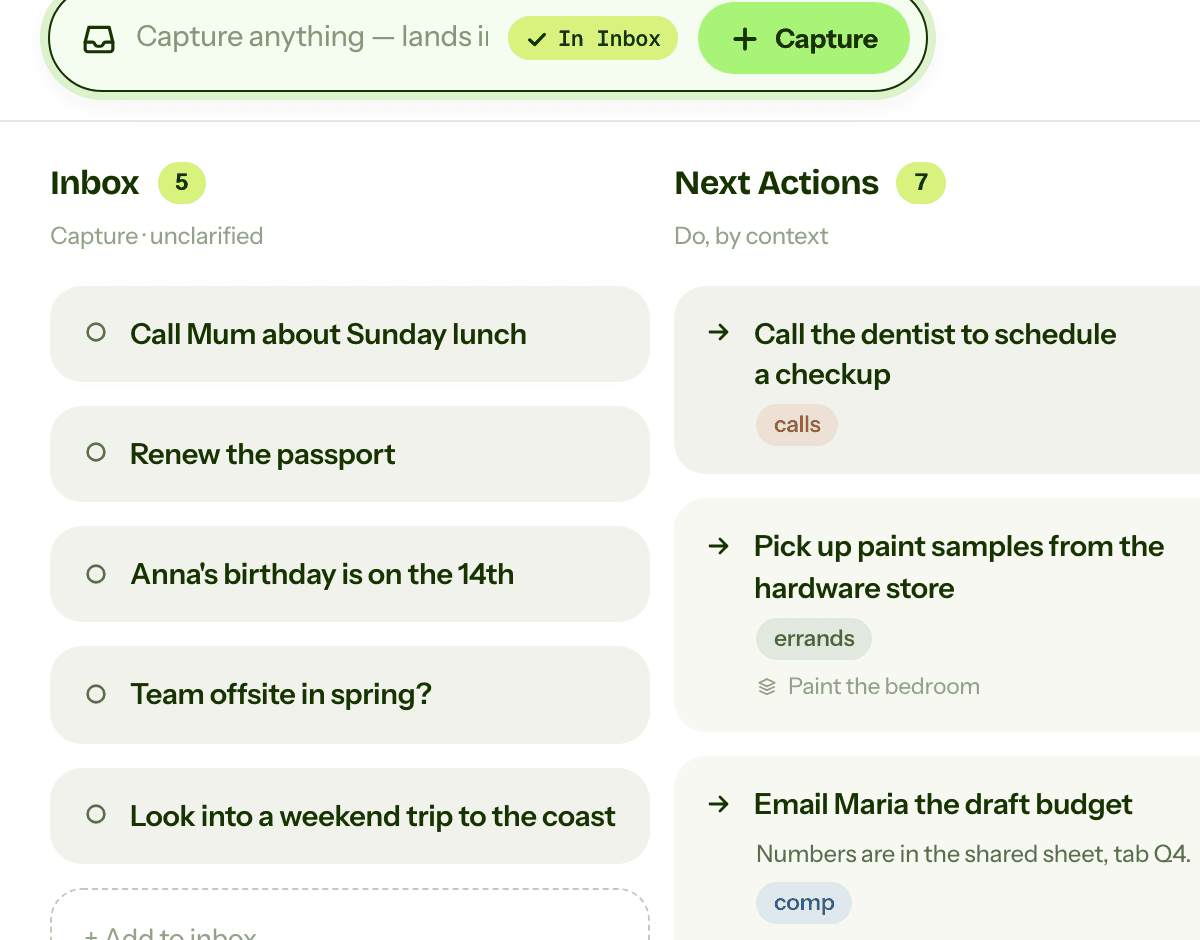
So mine gets everything: product bugs and release chores next to tax questions, errands, and trips I am still only considering. A capture takes a few seconds on whatever device is closest, and then it is out of my head. I capture from the web app while I work, from my phone in line at the supermarket, and from a chat window when I am already talking to an assistant about something else.
The step where GTD always died for me
Capture was never my problem. The method dies at the next step, clarify, where every scribble has to become a concrete next action with a context, or a project, or nothing. Doing that honestly for thirty captures is a chore, and skipping it quietly kills the whole system: an inbox full of vague notes is just another pile of guilt.
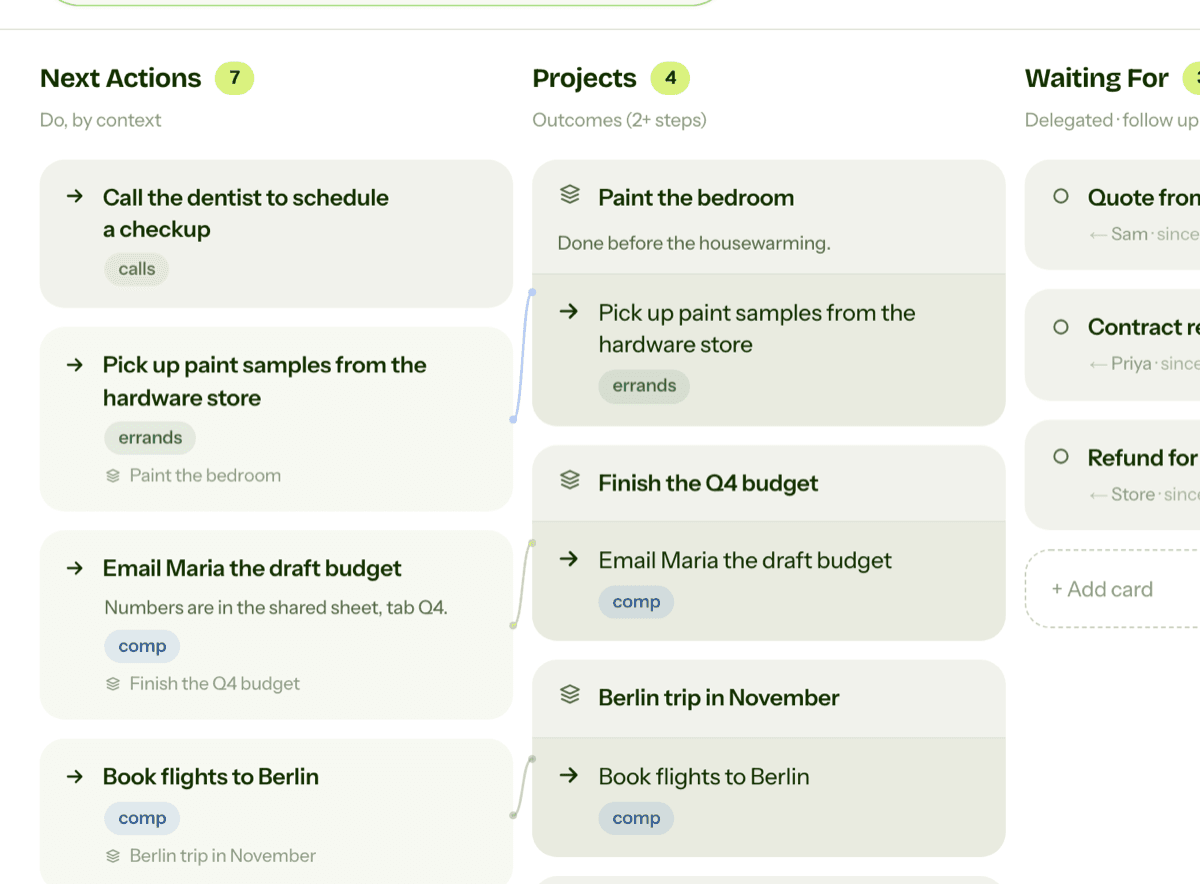
That chore is now the agent's job. A two-word worry becomes a next action with a context. A vague complaint about one of my apps becomes a project with a first step. I still decide what matters, but I no longer spend evenings turning notes into actions, and the inbox actually reaches zero. Language models turn out to be well suited to precisely the part of GTD humans abandon: reading a messy note and naming the real next action hiding in it.
Talking to the board from ChatGPT
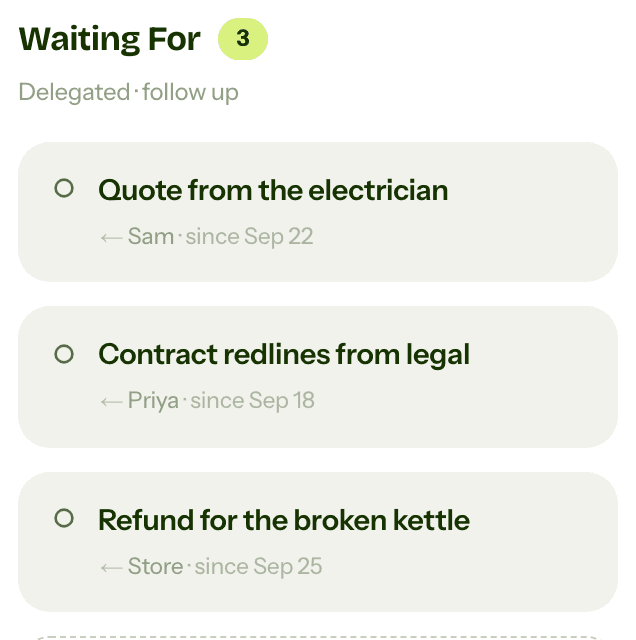
The board speaks MCP, so I connected it to the assistants I already use. In ChatGPT, GTD Brain shows up as an app: I can ask what is on my next actions for @errands before leaving the house, dump a thought into the inbox mid-conversation, or move a card to Waiting For because someone still owes me a receipt. The same connection works from Claude, and from Claude Code in a terminal. Whatever I change lands on the same board my phone shows.
The practical effect is that capture happens where I already am. I do not open a task app to record a thought; I say it to whichever assistant is in front of me, and it is on the board. Setup is a couple of minutes per assistant; the connection guides walk through it.
The cards that do themselves
This is the part people ask about when they see my board. Some cards on it carry a context that means “an AI agent can do this one.” A small script on my Mac watches for them and hands each card to its own Claude Code session. A research card comes back as a note with findings. A code chore comes back as a pull request I review. When a card needs a human decision after all, the agent says so on the card and puts it back.
The watcher is my own wiring on my own machine, not a feature of the app. But it only works because the board is plain, structured GTD underneath, with an API an agent can drive. A next action that is written as a real next action, with a context, is something a machine can act on. Vague lists cannot be delegated; clarified ones can. That, more than any single automation, is why I think GTD and AI fit together so well.
Travel plans, and a move between countries
Planning travel used to be where my systems fell apart, and right now the board is carrying the biggest version of that: a move to another country. Flights, bookings and relocation paperwork are just projects with next actions like everything else, and contexts absorb the chaos: @errands means whatever city I happen to be in, @calls is what I batch when offices are open.
My favorite card on the board right now: a visa application wants my full travel history for the last ten years. As a thought in my head, that is pure dread. As a card, it is a list of places to dig: passport stamps, old boarding passes, booking confirmation emails. I chip away at it in @desk sessions and the card remembers where I stopped, which is the whole difference between a trusted system and a nagging one.
What I still do myself
The weekly review. The agent walks me through it card by card, which lowered the barrier a lot, but the reviewing is mine: deciding a project is dead, admitting a Someday item will never happen, noticing a card that has been Waiting For someone for three weeks. Some weeks I skip it, and the board drifts until I do the next one. No AI fixes that, and I am not sure it should. GTD works because a person you trust keeps the system honest, and that person has to be you.
The deciding stays mine too. The agent proposes; every action it takes on the board is a visible, reversible step, and cards can be archived but never deleted. I would not hand my entire life to an autonomous system, and this setup does not ask me to. It takes the typing and the filing, and leaves the choices.
If you want to try the same setup
The board, the built-in agent and the guided weekly review are GTD Brain, on web, iOS and Android with one account across all three. The assistant connections are on the connect page, and GTD with AI explains how the agent applies the method. The watcher that runs my automated cards is not part of the product, but everything it relies on is: a clarified board, contexts, and an MCP connection any agent can use. Start with the inbox. Everything else follows from actually emptying your head into it.
Start free for a month →No charge for your first month · Cancel anytime